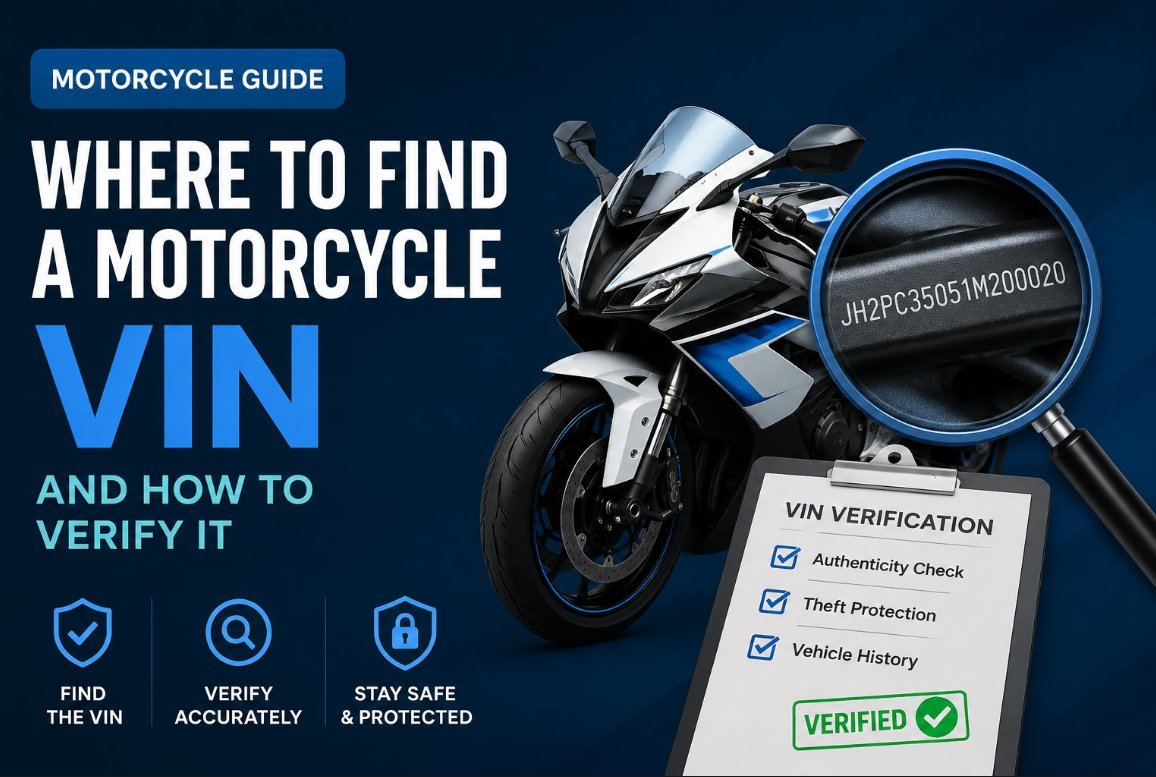
Buying a used motorbike is exciting. It can also go wrong fast — and when it does, it tends to go wrong in expensive and occasionally dangerous ways. Stolen bikes, outstanding finance, hidden accident damage, mileage fraud — all of these are at least as common in the motorcycle market as in the car market, and the consequences are just as serious.
The good news is that every motorcycle sold legally in Europe has a VIN — a Vehicle Identification Number — that gives you access to its full history. The trick is knowing where to find it and what to do with it once you have it.
What Is a VIN and Why Does It Matter?
A VIN is a unique 17-character code made up of letters and numbers. No two vehicles share the same VIN, which makes it the closest thing a vehicle has to a fingerprint. Every time the bike was registered, insured, serviced, stolen, involved in an accident, or sold, that event was logged against the VIN.
When you run a VIN check, you're pulling together records from dozens of databases — insurance companies, police theft registers, DVLA/NVDF records, finance providers, MOT/NCT databases, and more — and seeing the full picture of that specific bike's life.
If someone tells you a bike "has no history," that's either good (genuinely clean) or a warning (something has been deliberately concealed). A VIN check helps you tell the difference.
Where to Find the VIN on a Motorcycle
Unlike cars, where the VIN is almost always on the dashboard visible through the windscreen, motorcycle VINs can be in several places depending on the make and model. Here are the most common locations.
The steering head / headstock
This is the most common location on modern motorcycles. Look at the front of the frame, where the forks meet the frame — the VIN is typically stamped into the metal there. You may need to crouch down and look from below, or wipe away road grime to read it clearly.
The frame near the engine
On some models, particularly older or Japanese bikes, the VIN is stamped into the frame on the right-hand side, near the engine. It's often low down and can be partially obscured by the exhaust or engine casings.
The engine casing
Bikes also have a separate engine number, which is different from the VIN. You'll find it stamped on the engine casing itself, typically near the top. This number is useful for cross-referencing, but it's the VIN (frame number) that you use for a history check.
The registration document
The VIN is printed on the registration certificate (V5C in the UK, vehicle registration certificate in Ireland). If the seller can't produce the registration document, that's a significant red flag regardless of anything else.
Red Flags to Check Before You Even Run the VIN
Some issues are visible before you even pull out your phone to run a check.
Signs of VIN tampering
Look closely at the stamped characters. The stamping should be uniform, cleanly pressed into the metal, and consistent in depth and style across all 17 characters. If some characters look re-stamped, are slightly misaligned, or if the area around the stamp looks like it's been filed, welded, or re-painted, the VIN may have been altered — which almost always means the bike is stolen.
Mismatched documentation
The name on the registration document, the V5C or equivalent, should match the seller. If the seller says "I bought it off a mate and never transferred it," that's a story you'll hear from legitimate sellers sometimes — but also from people selling bikes they don't legally own. Treat any document mismatch as a reason for extra caution, not a reason to trust the seller's explanation.
No service history
A bike with no service stamps at all could be legitimate (the owner did their own servicing) or could mean that the history has been removed because it doesn't match the odometer. Ask about it directly, and judge the answer.
Running the VIN Check
Once you have the VIN — confirmed physically on the bike and matching the documents — you can run a proper check. Here's what a thorough motorcycle VIN check should reveal:
- Stolen status — whether the bike has been reported stolen to police in any of the databases we query
- Outstanding finance — whether there's an active hire purchase or loan secured against the vehicle (which means legally, the finance company, not the seller, owns it)
- Write-off / salvage status — whether the bike was written off by an insurance company and, if so, what category
- Mileage history — cross-referenced against MOT/NCT records, service logs, and inspection data
- Number of previous owners — and how long each held the bike
- Import history — whether it was registered abroad before entering Ireland or the UK
- Technical specification — engine size, colour, type — useful for verifying it matches what's in front of you
The Finance Issue Explained
This is the one that catches people out most often. If a seller took out finance on a motorcycle — a personal contract purchase, a hire purchase agreement, or a secured loan — the finance company has a legal interest in the vehicle. Until the finance is fully paid off, they effectively own it.
The seller might genuinely believe they can sell it, or they might know exactly what they're doing. Either way, if you buy a bike with outstanding finance and the seller doesn't use the proceeds to clear it, the finance company can legally repossess the vehicle from you. You lose the bike. The money you paid the seller is gone. And recovering it from a private seller is difficult and slow.
A finance check costs a fraction of a typical bike purchase, and it takes about 30 seconds. Run it every time.
What to Do After the Check
If the check comes back clean, great — you've confirmed the bike is what it appears to be, and you can proceed with confidence. If it flags anything — outstanding finance, a stolen marker, a write-off category, or a mileage discrepancy — you have a decision to make.
Minor issues (like an old Cat N write-off that's been properly repaired) aren't necessarily dealbreakers, but they should affect the price. Serious flags (stolen marker, outstanding finance, VIN mismatch) are absolute dealbreakers. Don't let the excitement of finding a bike you like override what the data is telling you.
Walk away. There will be another bike. There won't be another €5,000.